Rs 1 Lakh Reward
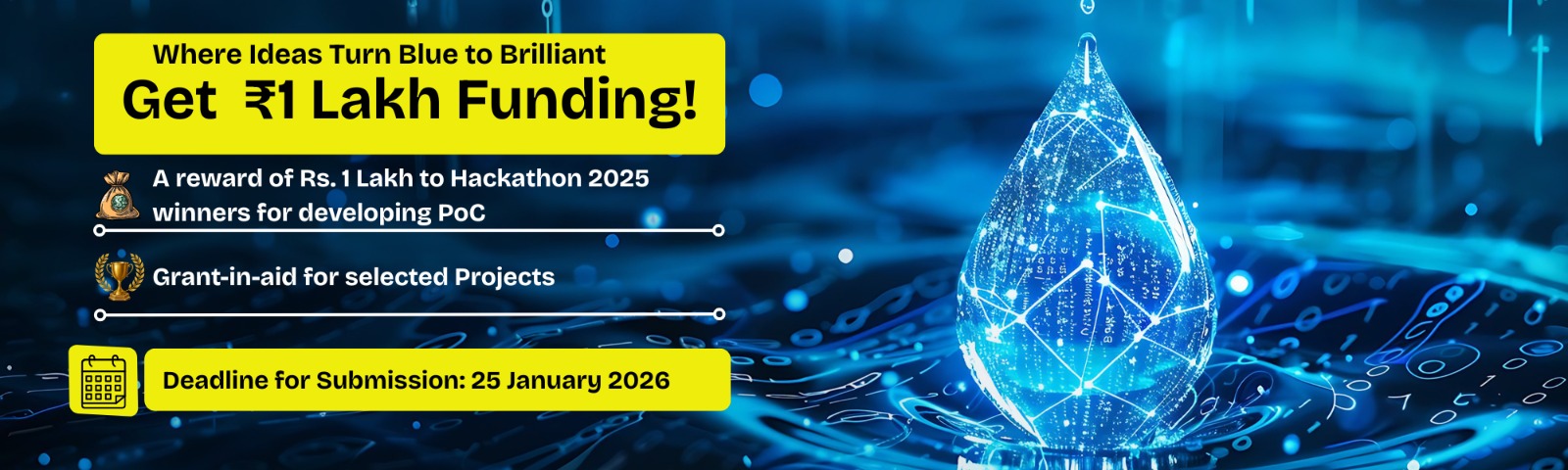
Reward to Hackathon winners for developing Proof-of-Concept tackling water challenges.
Bharat WIN is a national initiative of the Department of Water Resources, River Development and Ganga Rejuvenation, Ministry of Jal Shakti, Government of India , aimed at driving meaningful and technology-led transformation in India's water sector. The mission is to accelerate innovation by connecting scientific research, entrepreneurship, and grassroots initiatives to ensure accessibility, affordability, and sustainability. The initiative strengthens the research and innovation ecosystem by providing both institutional and financial support, encouraging development of technologies that can be tested, scaled, and deployed in real-world settings to solve critical water challenges.
To nurture innovation, DoWR, RD & GR, MoJS, will organize Jal Shakti Hackathons under Bharat WIN Initiative and invite calls for proposals that inspire creative solutions in priority areas such as water resource management, wastewater treatment, water-use efficiency, climate resilience, flood management, smart monitoring systems, precision agriculture, and urban hydrology. The National Institute of Hydrology (NIH), Roorkee, has been designated as Project Implementation Agency (PIA) for this initiative. The Hackathon winners will be awarded Rs 1 lakh for developing Proof-of-Concept (PoC). The selected proposals will be evaluated further for grant-in-aid.
Turn breakthrough ideas into impact with funding through the Bharat WIN.
Reward to Hackathon winners for developing Proof-of-Concept tackling water challenges.
Dedicated funding for developing full-scale prototypes/technology
Showcase your solutions to policy makers.
Focus areas for submission of proposals.
Applicants may formulate their problem statements by identifying water-related issues, preferably aligned with the given Focus Areas. A few identified problem statements are provided below, which may also be used as a basis for developing new ideas.
Development of an application for estimation of rooftop runoff yield and storage requirements. The system shall generate harvesting potential and site-specific design parameters considering rainfall statistics, sub surface details, groundwater table, roof area, and demand.
Development of a decentralized, low-cost system for segregation, volume reduction, and environmentally compliant processing of plastic waste. The solution shall emphasize energy efficiency, minimal secondary emissions, and operational scalability. These systems are useful to minimise soil and water contamination.
Development of an unmanned aerial vehicle (UAV) enabled monitoring framework for acquisition of river stage and in-situ water quality parameters through image processing. The system shall integrate onboard sensors, real-time telemetry, and processing modules to derive the river water level and quality parameters.
Design of a floating sensor for continuous measurement of river water levels and physicochemical parameters. The system shall enable wireless transmission/telemetry/IoT, and centralized data management.
Development of decentralized wastewater treatment system is for safe disposal of grey and black water. The system shall ensure compliance with the Government of India guidelines and standards. These systems reduce significant pollution load on rivers, water bodies and groundwater.
Development of a portable device for rapid detection of key chemical and bacteriological water quality parameters. The device shall support sensor-based techniques with on-site data processing.
Development of an integrated early warning system combining remote sensing, hydrodynamic modelling, IoT and real-time data. The system shall enable predictive risk assessment, alerts/warnings, and decision support.
Development of a system for assessment of water use efficiency across irrigation, residential, and industrial sectors. The system shall integrate metering data/releases/supply, usage, and performance indicators to suggest optimized water management.
Development of advanced tools/techniques and decision-support systems for water resources management and ensuring safe drinking water. The system shall leverage modelling, IoT, AI and real-time data for generating best management scenarios.
The drying of sludge and removal of moisture consumes substantial amount of power and energy. The energy efficiency can be enhanced through aeration, improving dewatering and advanced process control (SCADA etc.), improving energy recovery through biogas etc. An optimal mix of abovementioned factors with system design may be presented as a solution to the improved energy efficient system.
Characterization of sludge is very important for deciding upon its end use. System is to be developed for complete characterization of sludge instantaneously and bringing out different metals present in it, it can help in deciding the final use of sludge. In case complete characterization is difficult, the presence of heavy metal may be brought out by the system.
The use of sludge as a soil conditioner to enrich the soil nutrients and help in improving the productivity is an aspirational goal. An efficient cost effective process/technology may be developed for producing FCO compliant sludge.
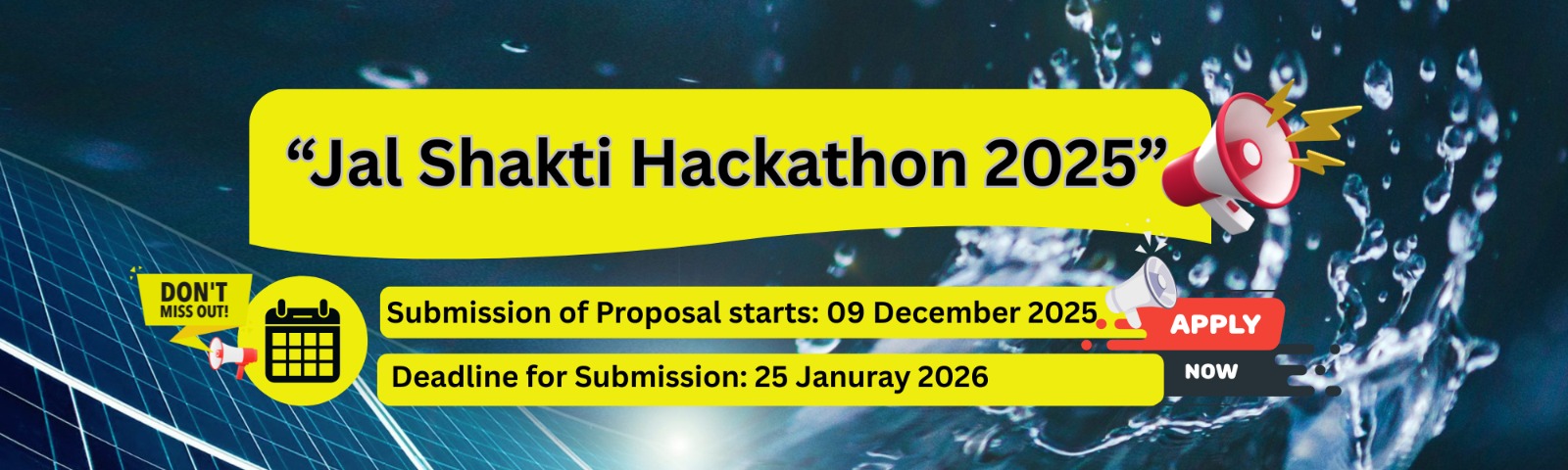
Proposals should be submitted on the portal, clearly mentioning the problem statement, by 25 January 2026.
Proposals should be based on the innovative ideas relevant to the Focus Areas.
Problem statement should be within 500 words. Additional information (optional), can be mentioned in less than 300 words.
The Problem statement should clearly mention deliverables/outcome in the form of prototypes, scalable models and deployable field-ready solutions.
Individuals as well as organizations are invited to submit the proposals; for details of eligibility, please see the Who Can Apply / Eligibility Criteria.
An individual can submit multiple proposals in this Hackathon.
To submit the proposal the details of the team are not required, such details will be sought during the submission of detailed proposal / PoC, if the proposal is selected for further evaluation.
Selected proposals will be called for an online presentation during the Hackathon.
Winners of Hackathon will receive Rs. 1 Lakh for submitting a comprehensive Proof-of-Concept (PoC).
Rewarded proposals will be evaluated for a grant-in-aid for developing full-scale prototypes/technology within 1 to 2 years.
The following Indian Organizations/ Institutions/private sector are eligible to submit proposals.
Startups, MSMEs, industries, and incubators.
Laboratories, R&D institutions and registered societies.
Academia, universities & colleges.
Indian NGOs registered under relevant Society Act, non-profit-making recognized Indian Private R&D Institutions/ Organizations.
Any other entities that are not covered under the above categories, including individuals.
A reward of Rs. 1 lakh for developing detailed Proof-of-Concept (PoC) proposals.
Grant-in-aid for eligible projects based on impact potential.
Launch of the online portal for information, registrations, and submission of proposals. Release of the detailed focus areas and technical guidelines.
Window for innovators to submit proposals in the identified focus areas.
Presentation of the selected proposal at Hackathon
The proposal submission form includes four steps:
For queries related to Bharat WIN, please reach out to:
Jal Vigyan Bhawan, Roorkee, District Haridwar, Uttarakhand - 247667, India.
Phone: +91-1332-249410
Fax: +91-1332-272123
Email: hackathon.nihr@gov.in